Hawberk
The King in YellowHawberk is an armourer in New York whose shop serves as both a working museum of medieval steel and a point of contact with the secret history manipulated by Mr. Wilde. To Hildred Castaigne, he first appears as a craftsman valued chiefly for the sound and spectacle of armour; by the end, however, Hawberk's concealed identity and recovered military pieces help connect the ordinary shop to the aristocratic and conspiratorial world that Hildred has only partly understood.
Identity and Introduction
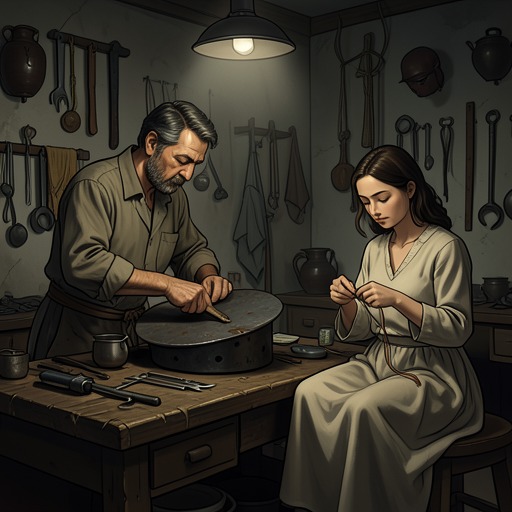
Hawberk works in a small, dingy shop bearing the sign “HAWBERK, ARMOURER.” He is introduced at the end of a passageway, riveting the worn greaves of an ancient suit of armour. His tools, the leathern apron, the little hammer, and the soft clash of mail establish him as a hands-on specialist rather than a merely commercial dealer. The shop's atmosphere is defined by the recurring sounds of metal: the hammer striking thigh pieces, chain armour jingling, and steel brushing against steel.
His professional authority extends beyond his own premises. Hawberk has been appointed armourer to the collections of the Metropolitan Museum and also supervises several private collections owned by wealthy amateurs. His work therefore joins public cultural institutions, private collecting, historical scholarship, and physical restoration. The armour is not treated as inert decoration: each piece carries a traceable history, and Hawberk's expertise allows him to reconstruct that history through ownership, provenance, and material recovery.
Craft, Knowledge, and the Missing Armour
Hawberk's central practical achievement is the completion of a famous suit known as the “Prince's Emblazoned.” A missing greave had been traced to a small shop on the Quai d'Orsay in Paris. Hawberk negotiated for it and secured it for his client, completing a suit whose ownership could be followed from 1450 through successive holders until it came into the possession of Thomas Stainbridge. After Stainbridge's superb collection was sold, Hawberk's client acquired the suit and continued the search for the missing part until it was located almost accidentally in Paris.
The search demonstrates Hawberk's defining professional quality: persistence without certainty. When asked whether he had continued looking despite having no assurance that the greave still existed, he answered that he had. His confidence is quiet and practical, grounded in the assumption that an incomplete historical object warrants sustained investigation. The recovered armour thus becomes a material counterpart to the hidden identities in the story: what appears lost may still survive, displaced in an obscure place and waiting to be recognized.
Hawberk later confirms that the missing pieces are not limited to the greave. He has found the tassets and the left cuissard of the same suit in a “vile old junk garret” at 998 Pell Street. The discovery fulfills Mr. Wilde's earlier information and gives the apparently casual reference to that address a concrete physical reality. Hawberk's knowledge is therefore not antiquarian ornament. It produces evidence, restores an object to completeness, and inadvertently verifies a secret that Mr. Wilde has used to unsettle him.
Concealed Identity and Conflict with Mr. Wilde
Hawberk's armourer identity conceals a more elevated one. Mr. Wilde repeatedly speaks of him as the Marquis of Avonshire and associates Constance with that hidden title. When Hildred raises the matter, Hawberk rejects it as impossible, but his denial is undermined by the visible trembling of his hand beneath the leathern apron. His body registers the pressure that his words attempt to conceal, while Constance rises in terror before he can fully answer.
The concealment places Hawberk in a dangerous relation to Mr. Wilde. Wilde knows enough of Hawberk's past to identify him by an aristocratic title and to name the place where the missing armour can be found. Hawberk's later admission that Wilde was right confirms that the information was not nonsense, even though Hawberk initially calls it so. The exchange turns the recovered armour into a piece of personal evidence: it proves Wilde's knowledge and exposes the vulnerability of the man who has tried to live under the simpler public identity of an armourer.
Hawberk is not presented as a passive victim of this exposure. His expertise and composure remain intact in the ordinary scenes of the shop, and he can speak authoritatively about a suit's history, acquisition, and restoration. Yet his authority is divided. In the workshop he controls the meaning of armour as a professional; outside it, Mr. Wilde can reinterpret the same man through the language of rank, lineage, and concealed allegiance.
Family and Social Connections
Constance is Hawberk's daughter, and the shop is also a domestic space in which she embroiders a banner from a coloured plate associated with the Metropolitan Museum. Her presence gives the armourer's establishment a family dimension, but her emotional life links the household to the Castaigne family. She is in love with Louis Castaigne, and Hildred observes that she has mistaken him for Louis when Hildred enters the shop. Hawberk is therefore connected to the Castaignes not only through his work and hidden identity but also through his daughter's relationship.
Hawberk appears to accept the developing attachment between Constance and Louis. During a later gathering, Louis offers Constance his arm and walks with her along the river wall while Hawberk watches them. The scene presents him as a father observing a possible future for his daughter, in marked contrast to the coercive ambitions Hildred entertains for the lives of those around him. His concern is not developed through extended confession, but it is visible in the way his attention follows the couple before he turns back to Hildred.
Role in Hildred Castaigne's Downfall
Hawberk's final major appearance occurs after Hildred enters Mr. Wilde's rooms in a state of triumphant delusion. Hildred believes himself crowned King and dresses in a white silk robe embroidered with the Yellow Sign, placing a diadem on his head as he anticipates an upheaval that will shake two hemispheres. Mr. Wilde is found with his throat torn open, and Hildred reacts with rage when the police seize and bind him.
Hawberk is among those who come to restrain Hildred. Hildred sees him after the policemen have immobilized him, alongside the ghastly face of Louis and the weeping Constance. The image gathers Hawberk's several roles into one final tableau: armourer, concealed aristocrat, father, witness, and agent of physical order confronting Hildred's imagined coronation. His presence helps return the scene from Hildred's fantasy of empire to the visible consequences of violence, arrest, and grief.
Hildred interprets the restraint as a political seizure, accusing those around him of having taken the throne and empire and warning them about the crown of the King in Yellow. The accusation is delusional, but it gives Hawberk an inverted symbolic role. The man associated with armour, titles, and recovered emblems is not shown claiming power; he is instead present when Hildred's claim to power collapses. Hawberk's final position in the narrative is consequently one of containment and witness rather than conquest.
Narrative Significance
Hawberk embodies the story's tension between material history and unstable interpretation. His work depends on exact objects, identifiable components, documented ownership, and patient restoration. Hildred, by contrast, converts armour, titles, crowns, and political language into instruments of a private mythology. The recovered pieces of the “Prince's Emblazoned” can be handled and located; the empire Hildred believes he has inherited exists only within his disordered account.
His concealed title also reinforces the story's recurring instability of names and identities. Hawberk is publicly an armourer, yet Mr. Wilde identifies him as the Marquis of Avonshire; the difference is not merely biographical but socially explosive, because it links a modest shop to aristocratic history and to Wilde's secret knowledge. Hawberk's refusal to explain himself fully leaves the identity suspended between denial and confirmation, while his trembling and later admission make the concealment legible without turning it into a complete public revelation.
The final contrast is between Hawberk's restoration of damaged historical objects and the destruction of the people who surround him. He can recover a missing greave, tassets, and cuissard and make an incomplete suit whole again, but he cannot repair the violent world represented by Mr. Wilde's death, Constance's tears, Louis's horror, and Hildred's confinement. Hawberk's craft offers continuity and tangible order; the narrative's ending shows that such order can preserve fragments of the past without preventing psychological and political catastrophe.